▎Summary
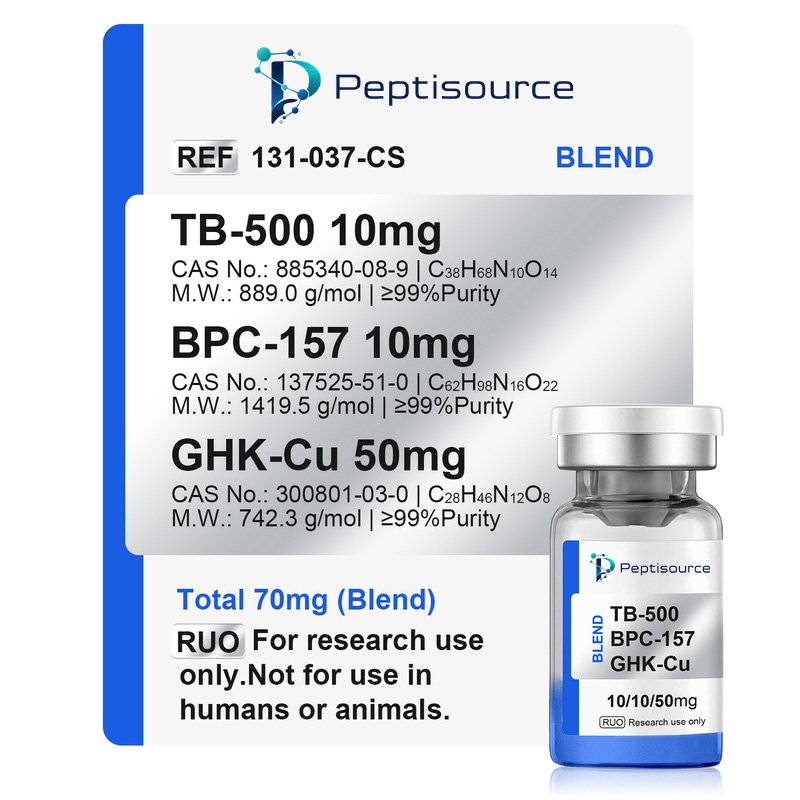
The combined use of TB500, BPC157, and GHK-Cu has many potential effects and benefits in wound healing, tissue repair, anti-inflammation, neuroprotection, and skin health and beauty.
1. Skin Health and Beauty
Improving skin elasticity:
GHK-Cu can promote the production of collagen and elastin, making the skin firmer and more elastic. Collagen and elastin are important components for maintaining skin elasticity. The effect of GHK-Cu can increase skin elasticity and reduce the appearance of wrinkles and fine lines. TB500 and BPC157 can promote the repair and regeneration of skin cells. They can accelerate the healing of skin wounds, reduce scar formation, and at the same time promote the metabolism of skin cells, making the skin healthier.
The combined use of these three substances may have significant effects in anti-aging and beauty skin care. They act on the skin together, improving the health and appearance of the skin from different aspects, making the skin younger and more vibrant.
Promoting skin repair:
For skin injuries such as burns, scalds, and cuts, these three substances can accelerate the skin healing process and reduce scar formation. BPC157 has shown a significant effect in promoting skin wound healing in a rat model of alkali burns. It can accelerate wound closure and promote granulation tissue formation, re-epithelialization, dermal remodeling, and collagen deposition[1]. TB500 and GHK-Cu may also accelerate the skin healing process by promoting cell growth and repair, as well as the production of collagen.
2. Wound Healing and Tissue Repair
Accelerating wound healing:
Both TB500 and BPC157 have the effect of promoting wound healing. TB500 can accelerate cell migration and proliferation, promote angiogenesis, and accelerate collagen synthesis and tissue repair. BPC157 also performs well in this regard. It can induce the production of nitric oxide and promote the migration of vascular endothelial cells, thus accelerating wound healing.
GHK-Cu helps the skin restore its self-repair ability by promoting the production of collagen and elastin. Collagen and elastin are important components of skin tissue, and their production is helpful for wound healing and tissue repair.
When these three substances are used in combination, their synergistic effect may further accelerate the wound healing speed and shorten the healing time. The three substances promote wound healing from different perspectives. TB500 and BPC157 mainly promote cell migration, proliferation, and angiogenesis, while GHK-Cu promotes the production of collagen and elastin. Under the combined action, the wound may heal faster.
Improving the quality of tissue repair:
TB500 contributes to the orderly repair of tissues. It may regulate cell growth and differentiation and promote the normal repair process of tissues, making the repaired tissues more orderly. BPC157 can enhance the integrity and stability of tissues. For example, in the study of tendon healing, BPC157 promoted the growth of tendon fibroblasts from tendon explants, increased cell survival under stress conditions, and promoted cell migration, which may help enhance the integrity and stability of tissues[2]. GHK-Cu can promote the regeneration of skin stem cells. Skin stem cells play a key role in tissue repair. They can differentiate into various skin cells, making the repaired tissues healthier and more elastic.
3. Anti-inflammatory Effect
Reducing the inflammatory response:
Both BPC157 and TB500 have anti-inflammatory properties. As an antioxidant, GHK-Cu can also neutralize the free radicals generated during the inflammatory process, further reducing inflammation. Free radicals can damage tissues during the inflammatory process, and the antioxidant effect of GHK-Cu can reduce the generation of free radicals, thus alleviating the inflammatory response.
The combined use of these three substances may have better therapeutic effects in treating inflammatory diseases such as arthritis and muscle inflammation. They exert anti-inflammatory effects from different mechanisms, and when used in combination, they may produce a synergistic effect and more effectively reduce the inflammatory response.
4. Neuroprotection and Nerve Repair
Promoting nerve repair:
BPC157 has a protective effect on the nervous system, which can promote the growth and repair of nerve cells and improve nerve function. For example, some studies have shown that the protective effect of BPC157 on the nervous system may be related to its activation of the Src-Cav-1-eNOS pathway[3]. GHK-Cu provides a favorable growth environment for nerve cells by promoting the production of collagen. Collagen also plays an important role in nerve tissue. It can provide support and nutrients for nerve cells and promote the growth and repair of nerve cells.
The synergistic effect of these three substances may help treat nerve injuries and neurodegenerative diseases such as Parkinson's disease and Alzheimer's disease. The three substances promote nerve repair from different angles. BPC157 and TB500 directly act on nerve cells to promote their growth and repair, while GHK-Cu indirectly plays a role by improving the growth environment of nerve cells.
About The Author
The above-mentioned materials are all researched, edited and compiled by Peptisource.