▎What is GHK-Cu?
GHK-Cu is a complex formed by glycyl-L-histidyl-L-lysine tripeptide and copper ions. Leveraging the synergistic action of copper ions and the tripeptide, it performs multiple critical functions in physiological activities. In skin repair and regeneration, it acts as a signaling peptide to induce fibroblasts to synthesize collagen, elastin, and glycosaminoglycans, enhancing skin firmness and elasticity while improving skin issues caused by aging or photoaging. During wound healing, it stimulates stratum corneum cell growth to accelerate closure while regulating inflammation by suppressing excessive IL-6 and TNF-α expression. It also promotes macrophage aggregation to release growth factors, aiding tissue repair and remodeling. Its potent antioxidant and anti-inflammatory properties regulate intracellular copper levels, enhance antioxidant capacity, and delay cellular aging. In pulmonary inflammation models, it mitigates lipopolysaccharide-induced acute lung injury and improves tissue inflammatory states. GHK-Cu benefits hair health by stimulating hair follicle cell activity, promoting melanin production, regulating energy metabolism, and aiding in hair loss improvement.
Conclusion
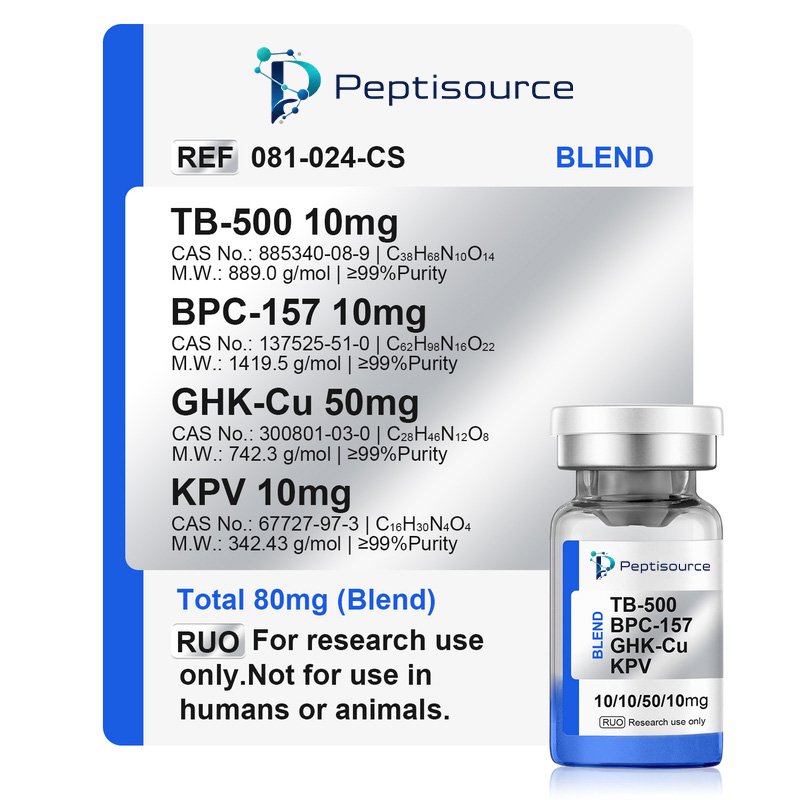
As a blend of TB 500, BPC-157, KPV, and GHK-Cu, Klow's synergistic effects manifest through the overlapping and complementary regulation of multidimensional physiological functions. TB 500 promotes cell migration and angiogenesis, BPC-157 enhances tissue repair and inflammatory regulation, KPV focuses on immune balance and local anti-inflammation, while GHK-Cu functions in antioxidant defense, skin regeneration, and microenvironment optimization. Together, they form a closed-loop system of “repair-anti-inflammation-immune modulation-microenvironment enhancement.”
Under this synergy, TB 500 and BPC-157 accelerate cell proliferation and matrix synthesis, while KPV mitigates excessive inflammation by inhibiting the NF-κB pathway, creating a stable environment for repair. GHK-Cu's antioxidant properties reduce free radical damage to newly formed tissues, and its vasoprotective effects synergize with TB 500's angiogenesis function to enhance local blood supply. KPV's bidirectional immune modulation balances the immune activation triggered by BPC-157 and GHK-Cu, preventing immune dysregulation. This synergy not only shortens tissue repair cycles but also improves repair quality and reduces scar formation risk, offering comprehensive regulatory advantages in scenarios such as wound healing, chronic inflammation, and skin aging.
About The Author
The above-mentioned materials are all researched, edited and compiled by Peptisource.
ALL ARTICLES AND PRODUCT INFORMATION PROVIDED ON THIS WEBSITE ARE SOLELY FOR INFORMATION DISSEMINATION AND EDUCATIONAL PURPOSES.
The products provided on this website are intended exclusively for in vitro research. In vitro research (Latin: *in glass*, meaning in glassware) is conducted outside the human body. These products are not pharmaceuticals, have not been approved by the U.S. Food and Drug Administration (FDA), and must not be used to prevent, treat, or cure any medical condition, disease, or ailment. It is strictly prohibited by law to introduce these products into the human or animal body in any form.